

The Market
As new innovative technologies are developed and adapted, building owners are realizing a return on investment they made in smart building systems. According to IDC Energy Insights, corporations spent $5.5 billion on intelligent buildings in 2012 worldwide. Expenditures are projected to rise to $18.1 billion by 2017, a 27.1 percent compound annual growth rate.
Some elements of smart buildings are tried and true, weatherization being one familiar example. Others involve new lighting technologies and other systems that are just beginning to break into the market. Still others can depend on access to renewable energy, and on top of that, the habits and behaviors of the people who use any particular building can have a great influence on efficiency.
There are about 500,000 commercial buildings and 35,000 industrial facilities in Canada, which combined account for about half of the country’s energy use. The annual energy costs for those buildings add up to a total of about $20 billion, and approximately 30 percent of that energy, $600 million, is used “inefficiently or unnecessarily.
Benefits to Building Owners
The IoT supported smart building is impacting building asset valuations. Historically, facility energy management has been a low priority of executives, who perceived the cost of energy as a bookkeeping entry with little impact on overall financial performance. World Green Building Council reported that 90 percent of typical building operating costs are associated with staff salaries, benefits, and occupancy related operating costs and issues. If energy and lease payments combined represent only 10 percent of the cost of doing business, it is easy to see why decision makers were not that interested in intelligent building solutions.
Studies are proving that smart buildings indirectly lower occupancy costs. A growing number of devices and programs are designed to optimize productivity and satisfaction by improving responsiveness to HVAC complaints, optimizing lighting to meet specific demands, and impact corporate social responsibility and sustainability. A smart building will provide building owners direct benefits including reduction in energy bills due to efficiency and operational improvements.
Benefits to Building Occupants
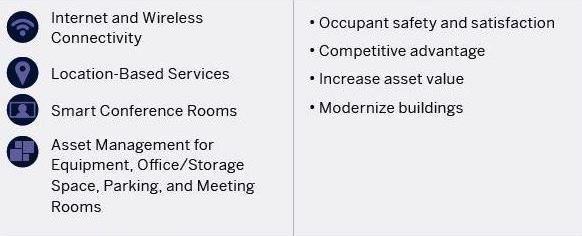
Real estate and facilities managers are revisiting how they value their facility assets to align with the new Millennial Generation which makes up the largest share of the workforce.
A recent study on the Millennial leadership found that work/life balance, training, technology/innovation, and pay equity are the four key issues prioritized by the next gen in the workplace. These stats underscore the value of intelligent building solutions today. Smart building solutions can give occupants access to data and a sense of control in parallel with their technology experiences in the bigger context. Two other studies suggest that when it comes to commercial buildings, the facilities management industry can benefit from IoT-enabled technology advancements.
Pro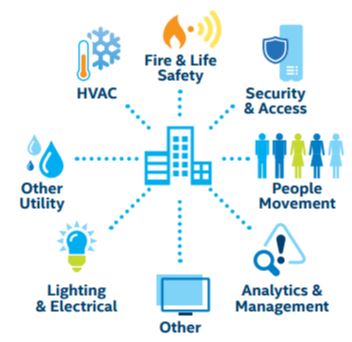 perty Stakeholder Priorities
Property owners and managers of small and medium-sized facilities understand significant cost savings and efficiency gains can be realized with building automation, but the expense of implementation has been a deterrent; however, this is changing.
Whether it’s environmental controls, communication interfaces, video surveillance, or energy conservation, Castle Inc. can help you get started today with IoT solutions that scale with your budget and schedule.
In this example provided by Intel, existing building systems, sensors, and devices are connected to the property’s IT network, allowing operations and IT to securely share information used to improve functionality of disparate building systems. This type of facility solution can be retrofitted on top; of existing building equipment without incurring the high capital costs associated with equipment replacement. Profitability can be further improved with incremental retrofit solutions that instantly take advantage of the power of the IoT (Internet of Things).